What is Voltage? Hint: (It's not Electrical Pressure)
- #electronics
- #physics
- #electromagnetism

You’ve probably heard that voltage is like “electrical pressure”, a force that pushes electrons through a wire. It’s a useful analogy for circuits, but it doesn’t explain why voltage exists or how it actually works.
The formal definitions are precise but unhelpful for intuition: “electrical potential difference” or “joules per coulomb”. They’re true, but they’re just restatements, not explanations.
To really understand voltage, you need to start with something more fundamental: charge separation and the electromagnetic force.
Electromagnetic Force
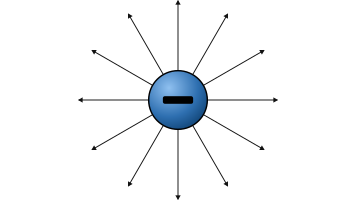 Everything begins with the fact that opposite charges attract and like charges repel. This is Coulomb’s law:
where is the electrical force, is the charge, the distance from the charge, and Coulomb’s constant
Voltage is caused by an electrical field and since electrical fields propagate at light-speed, electricity feels effectively instant.
Charge Separation creates Voltage
Because of the electromagnetic force two separated charges create an electric field.
where is the force between two charges, and are their magnitudes, is the distance between them, and is Coulomb’s constant.
A battery works by separating charges. Chemical reactions inside push electrons to one terminal and away from the other. Now you have:
- Negative terminal: lots of extra electrons
- Positive terminal: fewer electrons
These separated charges create an electric field, an invisible vector field of force that surrounds them. The field points away from the negative terminal and toward the positive terminal. This field is what we measure and call voltage.
Voltage measures Electrical Fields
The electric field is strong near the charges and weakens with distance (following the inverse-square law above). But measuring the raw field strength is awkward because it depends on how much test charge you use.
So we divide it out. We define a quantity that describes the field itself, independent of any particular charge moving through it: voltage.
Voltage is the potential energy per unit charge between two points A and B:
In SI units, that’s joules per coulomb. A 9V battery means every coulomb of charge has 9 joules of energy because of moving from negative to positive.
Mathematically:
where is the electrical field and the derivative of the distance
Don’t let the integral scare you. It just means: “add up the electric field strength along the entire path from A to B.” The result is one number (voltage) that tells you the energy landscape without needing to specify how much charge is moving through it.
Why the Water Analogy fails
The “water pressure” analogy works for circuit analysis (Ohm’s law, series/parallel) but breaks down when you ask why:
- Water is consumed, charge isn’t. Water flows away and is used up. Electrons circulate and return to the battery.
- Pressure exists at a point, voltage doesn’t. You can talk about water pressure at one spot in a pipe. Voltage only exists between two points.
- Water moves steadily, electrons move slowly and chaotically. Electrons drift at mm/s but are constantly colliding with atoms. The bulk motion is glacial.
- Pressure doesn’t require a reference point. Voltage is always relative to a chosen reference (ground). Change your reference and all your numbers change. The analogy is useful pedagogically for circuit analysis, but it completely obscures the real mechanism: electromagnetic force leads to charge separation, which creates an electric field, which is voltage, which exerts force on electrons, causing energy transfer.
Why Analogies persist anyway
Voltage is genuinely difficult to explain properly because it requires understanding electromagnetism, calculus and atomic structure.
The trade-off is worth it for basic circuits. But once you start asking “why,” the analogy breaks down. And that’s fine. It just means you’re ready for the real answer.